How to Find a Genuine Roasted Makhana Supplier in Bihar India
Looking for a genuine Roasted Makhana Supplier in India? Learn how to verify FSSAI licensing, product approval, factory infrastructure, hygiene standards and manufacturing capabilities before choosing a supplier.
How to Find a Genuine Roasted Makhana Supplier in India
The demand for roasted makhana has grown rapidly in recent years. What was once mainly consumed during fasting and religious occasions has now become a popular healthy-snacking option across India and international markets.
This growing demand has created new opportunities for distributors, wholesalers, retailers, private-label brands and first-time entrepreneurs. However, one question continues to trouble many business owners:
How do you find a genuine Roasted Makhana Supplier?
The challenge is not simply finding someone who can supply roasted makhana. The real challenge is finding a manufacturer who follows proper hygiene practices, operates from a suitable factory and holds the required food-safety licences for the products being manufactured.
An attractive price may help you save money on the first order, but poor quality or non-compliance can eventually damage your brand and customer trust.
Why Choosing the Right Roasted Makhana Supplier Matters
When you sell a food product under your own business or brand name, the quality delivered by your supplier becomes part of your reputation.
An unreliable supplier can create several problems:
Inconsistent taste and roasting quality
Poor hygiene during manufacturing
Improper storage of raw materials
Weak or non-food-grade packaging
Irregular product size and quality
Missing batch and manufacturing records
Delayed orders and inconsistent supply
Regulatory and food-safety risks
That is why supplier selection should not be based only on price, samples or attractive packaging.
A professional buyer should evaluate the supplier’s licence, approved product scope, factory infrastructure, hygiene standards and ability to maintain consistent quality.
1. Verify the FSSAI Manufacturing Licence
The first document you should request from a roasted makhana manufacturer is its valid FSSAI licence.
Do not stop after seeing an FSSAI number printed on a packet or shared on WhatsApp. Ask for the complete licence copy and check:
Name of the licensed company
Address of the authorised manufacturing premises
Category of licence
Kind of Business
Issue and expiry dates
Products approved under the licence
The company name and factory address mentioned in the licence should match the supplier’s actual business and manufacturing premises.
You can also verify licence details through the official FoSCoS portal.
2. Check the Kind of Business
Every FSSAI licence mentions the activities the Food Business Operator is authorised to conduct.
If a supplier claims to manufacture roasted makhana, its licence should include an appropriate manufacturing activity. A licence issued only for trading, retailing or another unrelated activity should not automatically be treated as proof of manufacturing authorisation.
Ask the supplier whether the product is manufactured in its own facility or sourced from a third-party manufacturer.
If a third party manufactures the product, request details of the actual manufacturer and verify its licence as well.
3. Ask for the FSSAI Product Annexure
The main FSSAI licence page does not always provide complete information about every approved food product.
The Product Annexure is therefore an important document. It helps buyers understand the food categories and products included within the manufacturer’s approved scope.
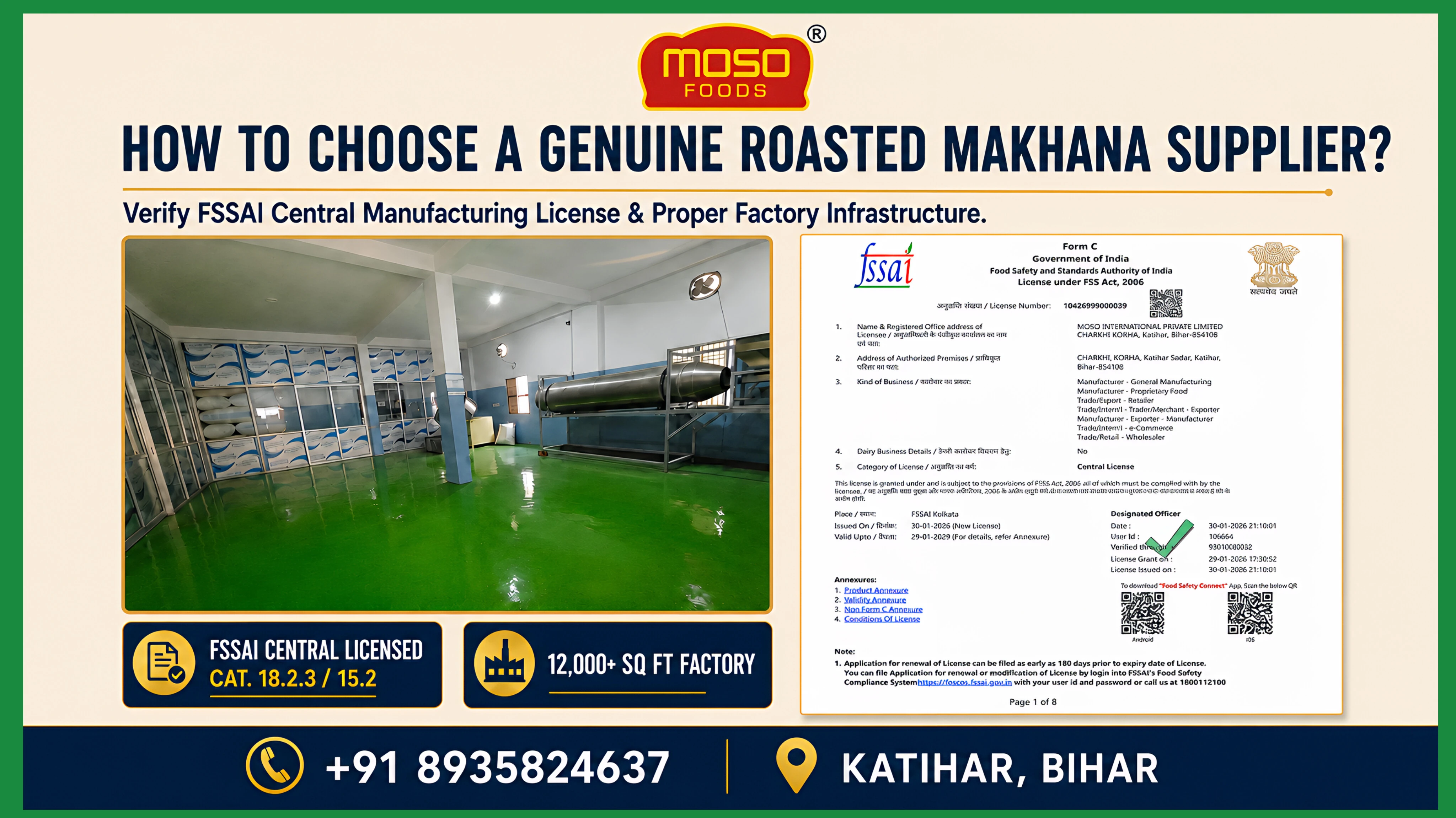
For example, the FSSAI licence of Moso International Private Limited includes makhana-based snacks and Roasted Makhana under the applicable scope of categories:
18.2.3 – Dry fruits and nuts-based snacks and savouries
15.2 – Processed nuts, including coated nuts and nut mixtures
The appropriate product category can depend on the formulation, ingredients and licensing classification of the product. Buyers should verify the supplier’s actual Product Annexure instead of relying only on verbal claims.
4. Inspect the Factory Infrastructure
A genuine Roasted Makhana Supplier should have suitable infrastructure for processing, roasting, seasoning, storage and packaging.
Ask for a factory visit or recent, unedited photos and videos of the manufacturing facility.
Check whether the facility has:
A separate processing or roasting area
Clean and food-safe flooring
Suitable roasting equipment
Proper ventilation
Raw-material storage
Finished-product storage
Packaging and sealing equipment
Cleaning and sanitation arrangements
Pest-control measures
Employee hygiene systems
A supplier may have a valid food licence, but the condition of the factory will tell you how seriously the company follows hygiene and manufacturing discipline.
5. Understand the Hygiene and Food-Safety Process
Roasted makhana is a ready-to-eat food. Consumers usually open the pack and eat it directly without any additional cooking.
Hygiene during processing and packaging is therefore extremely important.
Ask the manufacturer:
How is raw makhana inspected before roasting?
How often is the processing area cleaned?
Are workers required to use gloves, masks, caps and uniforms?
How are seasonings and ingredients stored?
How is cross-contamination controlled?
Is pest control conducted regularly?
How are rejected or damaged products handled?
Are food-contact surfaces cleaned and maintained?
A responsible supplier should be comfortable answering these questions.
6. Evaluate Product Quality and Consistency
Before placing a bulk order, request samples from more than one production batch.
Check the product for:
Size and appearance
Crunchiness
Roasting consistency
Flavour distribution
Oil content
Broken or burnt pieces
Aroma and freshness
Packaging and sealing quality
One good sample is not enough. The supplier should be capable of maintaining the same quality across repeated orders.
For private-label products, confirm the agreed specifications in writing. These may include makhana grade, flavour, pack size, net weight, packaging material, shelf life and permitted quality tolerance.
7. Check Packaging and Labelling Support
Professional packaging protects the product and helps maintain freshness.
Ask whether the supplier can support:
Zipper pouches
Pillow pouches
Paper jars
Plastic jars
Bulk packs
Private-label packaging
Barcode and batch printing
Nutrition information
Manufacturing and expiry details
FSSAI-compliant labels
If you plan to launch a private-label makhana brand, make sure the manufacturer understands packaging and labelling responsibilities before printing begins.
8. Confirm Production Capacity and Delivery Reliability
A supplier may be suitable for a small trial order but unable to support your business as demand grows.
Ask about:
Daily or monthly production capacity
Minimum order quantity
Average production lead time
Availability of raw makhana
Flavour-development capability
Packaging procurement time
Dispatch and logistics support
Ability to handle repeat or seasonal orders
A reliable supplier should provide practical commitments instead of unrealistic promises.
9. Do Not Choose a Supplier on Price Alone
Price is important, but an unusually low quotation should be evaluated carefully.
A lower price may sometimes result from:
Inferior raw makhana grade
Higher broken-piece percentage
Weak packaging material
Inconsistent seasoning
Poor hygiene standards
Lack of quality-control processes
Inadequate documentation
The cheapest supplier can become the most expensive option if you face customer complaints, product returns or reputational damage.
Compare suppliers on overall value, not only the price per pouch or kilogram.
Why Businesses Choose Moso Foods
Moso Foods, operated by Moso International Private Limited, is a Makhana Manufacturer and Supplier based in Katihar, Bihar.
Our manufacturing capabilities include:
12,000+ sq. ft. manufacturing facility
FSSAI Central Licensed operations
Raw and Roasted Makhana supply
Applicable product scope under categories 18.2.3 and 15.2
Bulk and wholesale supply
OEM manufacturing
Private-label packaging
Multiple roasted makhana flavours
Domestic and export support
Our focus is not limited to supplying products. We work with businesses that value hygiene, quality, compliance and long-term supply relationships.
Final Checklist for Selecting a Roasted Makhana Supplier
Before placing your order, confirm that you have checked:
Valid FSSAI licence
Correct company and factory address
Relevant manufacturing Kind of Business
Product Annexure
Approved roasted makhana scope
Factory infrastructure
Hygiene and sanitation processes
Product quality and consistency
Packaging capability
Production capacity
Delivery schedule
Batch and billing documentation
A genuine supplier should be transparent about its documentation, manufacturing process and quality standards.
Build Your Makhana Business with the Right Partner
The success of a roasted makhana business depends heavily on the manufacturer behind the product.
Do not choose a supplier only because the quotation is lower. Choose a manufacturing partner who can protect your business through consistent quality, hygienic production and responsible compliance.
If you are looking for a reliable Roasted Makhana Supplier, OEM manufacturer or Private Label Makhana Partner, connect with Moso Foods.
Call or WhatsApp: +91 8935824637
Email: info@mosointernational.com
Website: www.mosointernational.com
Location: Katihar, Bihar, India
Choose hygiene. Choose quality. Choose compliance. Build a better and more trustworthy makhana business.
Frequently Asked Questions
How can I verify a roasted makhana supplier’s FSSAI licence?
Ask for the complete FSSAI licence and verify its number, company name, premises address, validity, Kind of Business and Product Annexure. Licence details can also be checked through the official FoSCoS portal.
Is seeing an FSSAI number enough?
No. A licence number alone does not confirm that roasted makhana manufacturing is included in the approved scope. Check the licence type, Kind of Business and Product Annexure.
What should I check during a factory visit?
Inspect the roasting area, flooring, equipment, storage, packaging section, employee hygiene, cleaning arrangements and pest-control practices.
Does Moso Foods offer private-label roasted makhana?
Yes. Moso Foods supports OEM and private-label requirements, including different flavours and packaging formats, subject to order and packaging specifications.
Where is Moso Foods located?
Moso Foods operates from Katihar, Bihar—one of India’s leading makhana-producing regions.